Insights · Article · Security · May 2, 2026
Object lock patterns, vault segmentation, regular restore drills, and the exact alignment required between IT RTOs and cyber insurance expectations when criminals target corporate backups.
Modern ransomware operators are highly sophisticated adversaries whose primary objective is entirely focused on deleting, encrypting, or securely exfiltrating your backup infrastructure before touching a single piece of production data. When advanced persistent threat groups successfully penetrate an enterprise network, they will inevitably spend weeks performing quiet network reconnaissance. During this dwell time, they meticulously locate data centers, identify storage arrays, and slowly harvest privileged administrative credentials. By the time the visible ransomware payload finally detonates and locks user workstations, the attackers have already systematically destroyed every available avenue of technical recovery the organization possessed.
Consequently, relying solely on traditional daily or weekly tape backups and standard offsite replication completely fails in the current threat landscape. Immutable storage architectures, strictly enforced air gapped physical or logical copies, and heavily segregated administrative control planes are no longer considered paranoid overreactions. They represent the absolute bare minimum baseline for any serious corporate recovery architecture.
Systematic threat modeling immediately exposes the fundamental weakness of most backup strategies: the backup administrative account itself. If an Active Directory domain administrator possesses the inherent access privileges to simultaneously manage both the primary production data environment and also the highly sensitive backup vaults, immutability settings do absolutely nothing to stop an attack. Immutability controls that are centrally managed by the identical identity provider only serve to slow down honest human mistakes. They offer literally zero resistance against highly determined threat actors equipped with stolen domain administrator credentials.
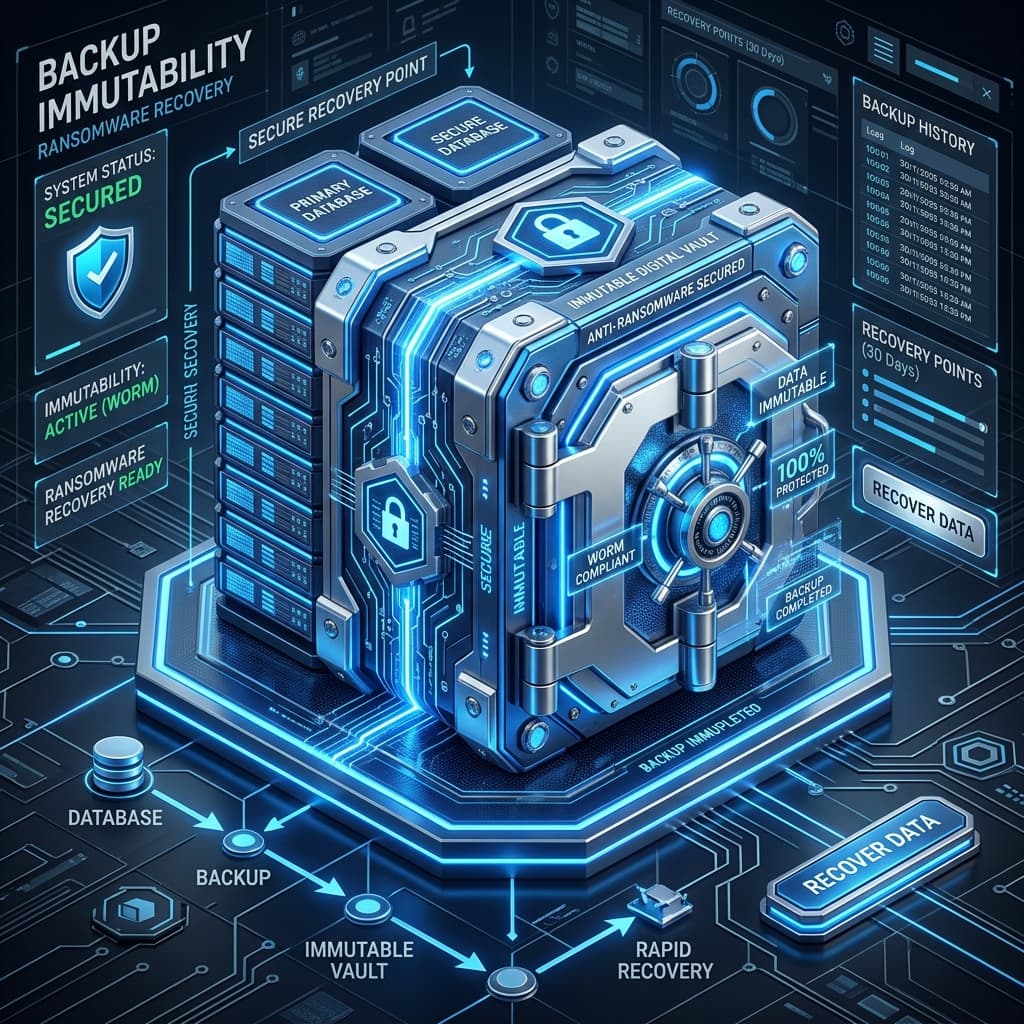
To mitigate this structural risk, organizations must fiercely segment their vault infrastructure. The backup administrative plane must utilize an entirely isolated identity provider, completely decoupled Active Directory domains, and mandate strict multifactor authentication utilizing physical security keys rather than easily interceptable SMS tokens. Furthermore, critical catastrophic actions like vault deletion must fundamentally require multiparty authorization mechanisms. When a single administrator requests to delete an entire bucket, the system must securely hold that request in escrow until a secondary designated security officer cryptographicly signs and approves the destructive action.
Cloud storage object lock policies require precise legal and operational input. While indefinite data retention might theoretically seem like the safest security posture, it directly creates immense privacy and compliance conflicts. When regulatory frameworks like the European GDPR or the California CCPA legally mandate the permanent deletion of specific consumer data upon request, immutable buckets that physically cannot be altered place the organization in immediate noncompliance.
Therefore, storage buckets must be granularly tuned and organized by data classification. Critical immutable system images may require an incredibly rigid three year retention lock, while massive consumer analytics datasets might only utilize a rolling highly restrictive seven day retention lock to balance rapid recovery capability against strict legal deletion mandates.
Another crucial area of focus is distinguishing between application consistent backups and basic crash consistent copies. When dealing with highly complex transactional databases, simply taking a storage array snapshot often creates a technically corrupted, functionally useless database image if the application was actively writing heavy transactional logs during that exact millisecond. It is absolutely vital to explicitly document which specific critical workloads require full application consistent quiescence methods versus those tolerant of basic storage snapshot technologies. Administrators must validate restorative procedures matching these exact technical assumptions.
Simulated recovery drills must comprehensively evaluate partial restores and hyper specific point in time data targets. Simulating a full datacenter restoration fantasy is often an intellectual security theater exercise that rarely reflects actual incident realities. Real world ransomware events typically require surgeons, not sledgehammers. IT teams frequently need to recover precisely three corrupted SQL tables from exactly twelve minutes before the suspected intrusion began, without disrupting the other hundreds of healthy tables running in parallel on the very same cluster.
Detailed tabletop exercises invariably reveal missing or outdated runbook steps significantly faster than any annual compliance audit ever could. When engineering leadership creates an unpredictable, high stress mock scenario, they quickly discover precisely which key personnel lack proper administrative access, which critical decryption keys are mysteriously missing, and how long a seemingly simple terabyte restoration physically takes to traverse the corporate network backbone.
The financial stakes surrounding these practices are astronomically high. Cyber insurance underwriters and their technical questionnaires increasingly demand verifiable, cryptographic proof of regularly tested offline or deeply immutable copies. Insurers actively track exactly how frequently an organization executes full technical restoration drills. Failing to accurately maintain this continuous operational evidence will rapidly result in denied insurance payouts following a massive catastrophic breach.
Migrating to advanced cloud vendor managed services certainly shifts the operational burden, but shared responsibility models clearly dictate that your explicit configuration choices completely define your survival. A heavily misconfigured S3 bucket policy or a poorly scoped IAM role has historically caused equally massive public data leaks and completely unrecoverable data deletions. Cloud providers elegantly provide the highly complex immutability tools, but the organization wholly assumes the immense responsibility for configuring them flawlessly.
Finally, comprehensive telemetry monitoring must actively alert operational security teams to any anomalous backup job failure, highly suspicious bulk deletion API calls, or completely unexpected retention policy modifications. These events must be aggressively prioritized and explicitly treated exactly like highly critical active intrusion security signals, rather than mundane infrastructure alerts silently queued in a backend ticketing system.
We facilitate small-group sessions for customers and prospects without requiring a slide deck, focused on your stack, constraints, and the decisions you need to make next.