Insights · Article · Cloud · May 8, 2026
Warehouse credits, slot contention, spilling to remote storage, and prioritization frameworks when every team believes their dashboard is the most important.
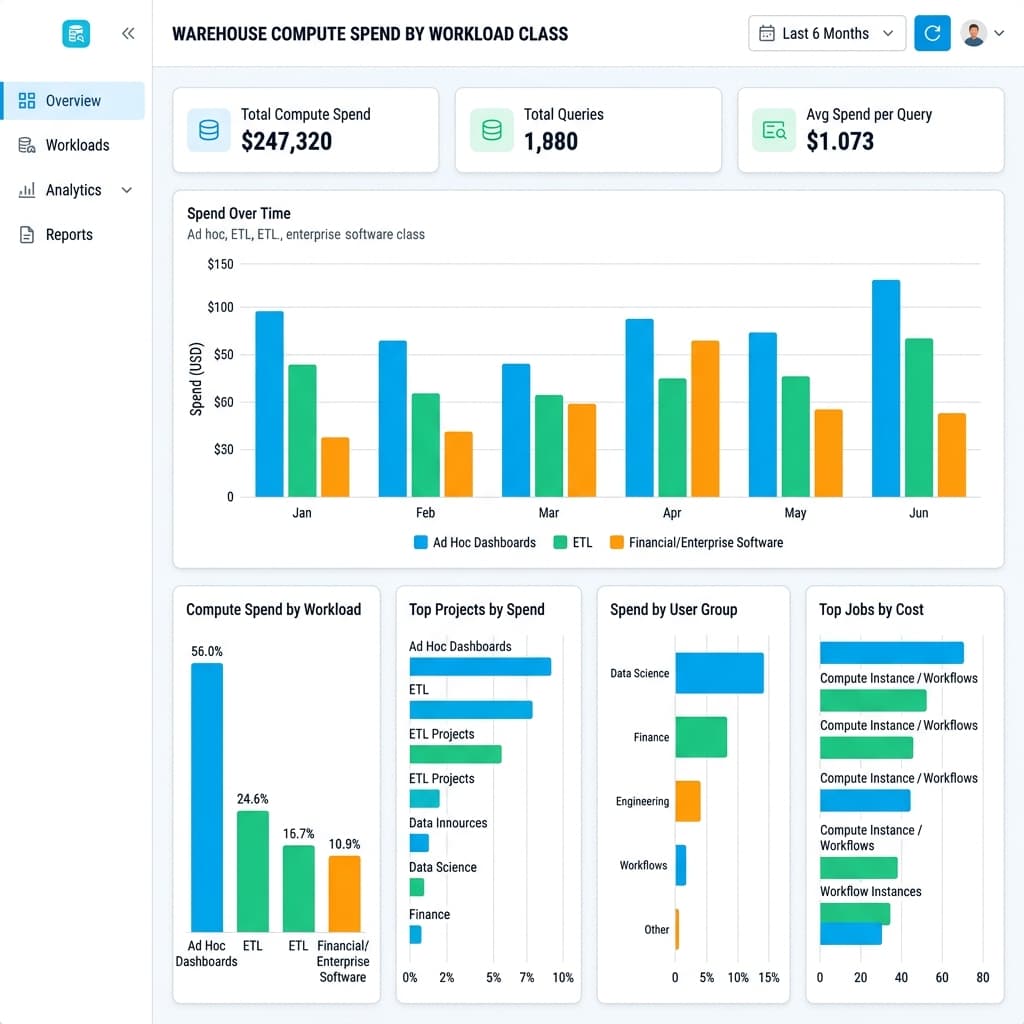
Cloud warehouses strictly bill you while queries run, transforming unoptimized SQL directly into immediate operational financial losses. Ad hoc exploration tools, complex business intelligence dashboards, and massive batch extraction jobs inherently compete for the exact same processing pools unless platform engineering leaders securely align on isolation policies and hard utilization guardrails.
Start by explicitly classifying workloads into distinct operational tiers like interactive, scheduled, and archival. Interactive dashboard users require millisecond response times and dedicated compute nodes, while bulk ingestion jobs can comfortably wait in a queue for cheaper spot pricing instances. Each specific classification class receives hard financial budgets, isolated clusters, and strict timeout policies distinctly matched to their intended business purpose.
Triage slow analytical queries systematically with raw execution plans that explicitly reveal remote resource spilling, structural data skew, and entirely missing clustering keys. Data spilling to remote object storage mid query will devastate performance profiles in ways that adding more compute nodes simply cannot fix. Employing optimizer query hints should always represent an absolute last resort after repairing the underlying physical data layout on disk.
Materialized views and incremental transformation models dramatically reduce repeated full table scans for popular reporting dimensions. They do add fundamental freshness obligations that a specific named engineering team must explicitly own and operate in production. If a materialized view becomes stale, the resulting business intelligence data presents a false operational picture to executives.

Strict concurrency limits protect foundational shared services effectively. Without explicit queue controls and admission barriers, one poorly structured marketing experiment featuring an accidental cross join can completely starve the required computing resources necessary for the month end corporate finance close.
Semantic layers and unified metric definitions logically reduce duplicate business logic that silently multiplies underlying compute resources. When five distinct teams write five unique queries to calculate the identical daily active user metric, the core infrastructure pays for that architectural friction five separate times.
Financial operations partnerships should regularly translate wasted terabytes directly into headcount hiring equivalents. Concrete business narratives consistently beat arbitrary raw credit consumption numbers when presenting efficiency initiatives to the executive suite.
Finally, mandate the scheduled automated deletion of unused tables, obsolete testing sandbox environments, and ancient daily snapshots. Accumulating storage creep represents completely quiet budget theft that slowly strangles innovation capital over multiple quarters.
We facilitate small-group sessions for customers and prospects without requiring a slide deck, focused on your stack, constraints, and the decisions you need to make next.