Insights · Article · Engineering · Apr 9, 2026
OCR, extraction, validation, and human-in-the-loop queues that keep straight-through processing honest when models face messy real-world paperwork.
Commercial banking and insurance providers promised perfectly automated processing pipelines for many years. Reality still stubbornly includes physical fax shadows, low resolution mobile photo uploads covered with extreme glare, and messy handwritten contractual amendments. Modern document intelligence pipelines only succeed when they architecturally embrace physical imperfection and intelligently route raw model uncertainty directly to specialized human reviewers quickly.
Ingestion layers must aggressively standardize file formats extraordinarily early without accidentally permanently destroying any native legal evidence. Complex compliance audits and detailed fraud investigations occasionally require retrieving original analog artifacts. You must securely store completely immutable originals immediately alongside their normalized mathematical derivatives used specifically for machine learning pipelines.
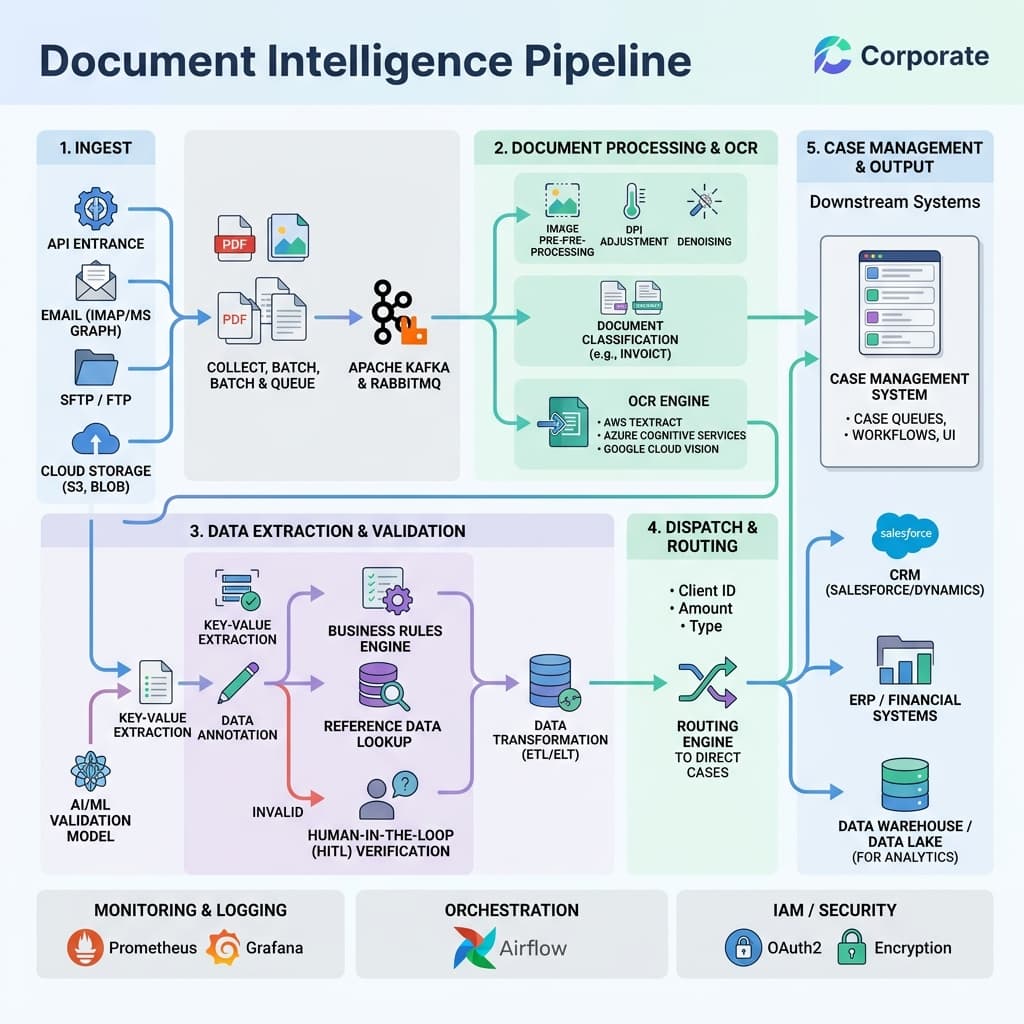
Artificial intelligence model selection carefully balances overall extraction accuracy, overall inference latency, and total compute cost. High volume simple intake forms may utilize incredibly lightweight local extractors while structurally complex commercial loan covenants require routing to significantly heavier foundational models coupled with rigorous ensemble logic checks. This distributed cost per decision should always remain completely transparent to relevant business product owners.
Formal validation rules directly encode strict business logic securely inside the pipeline. Basic cross field arithmetic, sequential date ordering logic, and statutory regulatory caps must all execute flawlessly. Machine learning confidently proposes values while deterministic structural rules mathematically protect your system from accepting confident nonsense when underlying training datasets inherently drift.
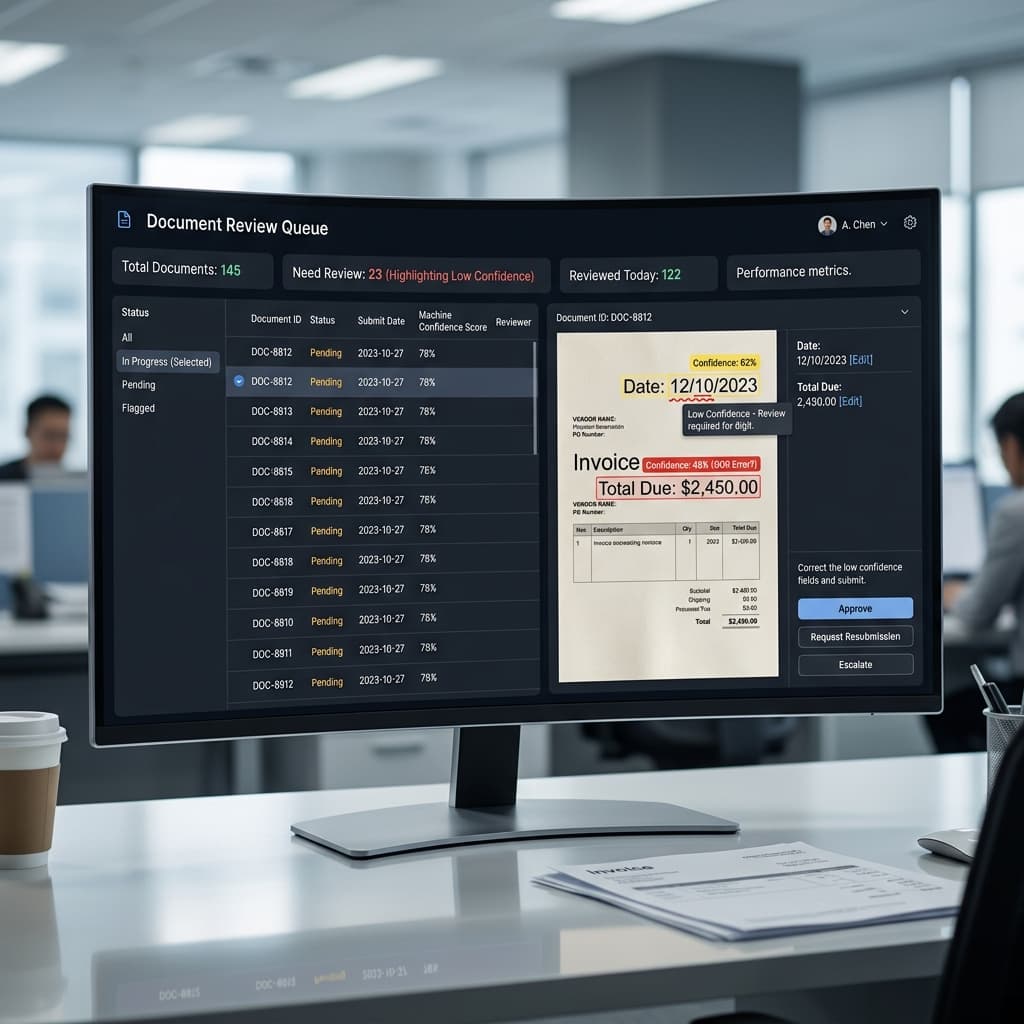
Manual operations queues desperately require thoughtful software ergonomics. Deliberately highlight any low confidence textual tokens, prominently display original source bounding boxes directly alongside the extracted text, and securely preload all relevant existing customer account context. Baseline throughput management metrics should strongly include internal reviewer fatigue indicators to prevent massive burnout driven compliance errors.
Automated continuous feedback loops fundamentally close the overall model quality gap. Whenever professional reviewers actively correct systematic extraction errors, those specific labels should quickly return to central training pipelines backed by incredibly strict governance for protected personally identifiable information. Note that privacy anonymization techniques that strip away too much semantic context will entirely sabotage your future model improvement cycles.
Network security architecture intrinsically intersects with any external data intake pipeline. Automatic malware scanning protocols, malicious content disarm methodologies, and strict least privilege access controls applied to final case storage repositories represent foundational baseline security. System exfiltration executing secretly via fake commercial loan applications is a highly recognized modern attack vector.
Executive strategic reporting should strongly emphasize the true aggregate automation rate, categorize specific exception reasons, and visualize exact case decision time distributions. Presenting a flat simplistic accuracy percentage often deliberately hides deep financial pain occurring constantly within the long tail of exceptionally messy unstructured documents.
Forward looking architecture roadmaps must intelligently prepare for complex multilingual support, wildly fluctuating mobile optical capture quality, and eventual vendor portability requirements. Building enterprise document intelligence represents a very long journey where your core architectural integration decisions should age gracefully long after current frontier models commoditize.
We facilitate small-group sessions for customers and prospects without requiring a slide deck, focused on your stack, constraints, and the decisions you need to make next.