Insights · Article · Engineering · Apr 16, 2026
Governance for flag lifecycles, kill switches in regulated domains, and telemetry that proves canaries before you widen blast radius.
Feature flags wonderfully empower engineering teams to physically separate deployment release boundaries from active customer exposure, which significantly accelerates production learning cycles while massively reducing big bang architectural deployment risk. At massive enterprise scale however, these exact same toggles rapidly become unmanageable configuration debt, strict regulatory compliance hazards, and disastrous sources of totally inconsistent user experiences if central platform teams refuse to ever deliberately retire them.
Meticulous governance effectively starts with rigid naming conventions and provable ownership logic. Every single active platform flag absolutely must possess a verified human owner, a mathematically enforced sunset date, and a heavily documented operational risk categorization. Permanent structural infrastructure toggles functionally represent complex service configuration rather than temporary experiments, and these specific switches must securely live within highly restricted administrative tools controlled by strict change management review.
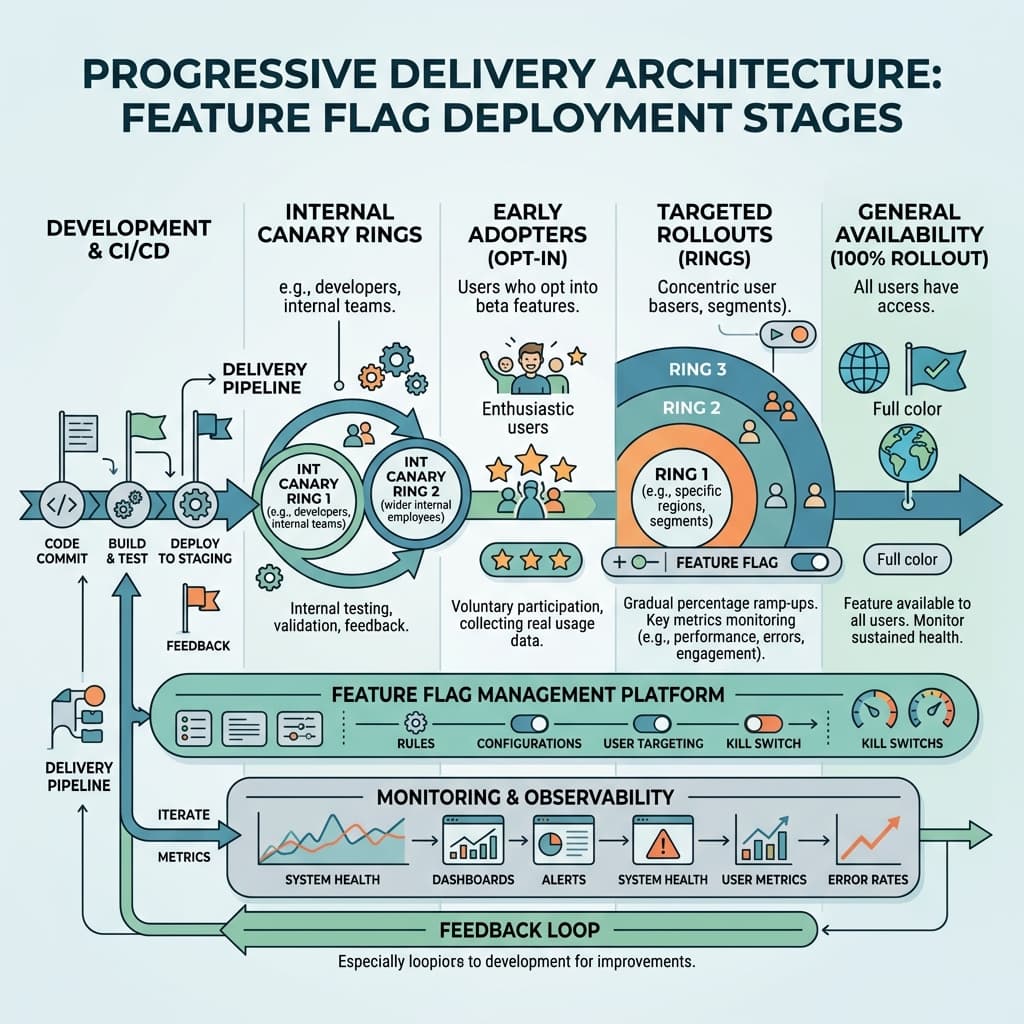
True progressive delivery fundamentally requires sophisticated deep observability segmented strictly by cohort. If your engineering squad cannot reliably mathematically slice systemic backend latency, error volumes, and core transactional business metrics cleanly by the exact user flag state, you are entirely just guessing wildly in production. Invest incredibly heavily in deterministic header tagging and intelligent distributed tracing sampling long before carelessly widening exposure percentages.
Highly regulated financial or healthcare features actively demand incredibly strict operational controls. Explicit required approvals, cryptographically immutable audit logs, and rigid separation of duties established clearly between flag authors and flag approvers closely mirror traditional strict change management compliance expectations. Executing an emergency production kill switch always legally requires a comprehensive formal post incident review.

Client side evaluation flags predictably leak competitive intentions directly to deeply curious technical users. Treat public frontend configuration bundles entirely as completely non secret public information. Robust server side flag evaluation strictly protects highly sensitive marketing launch experiments and dynamic tiered pricing tests from external competitive discovery.
Platform testing strategy MUST comprehensively cover nested flag combinations rather than just naively testing binary on and off state paths independently. Catastrophic combinatorial explosion is entirely real; QA teams must mathematically prioritize highly risky feature intersections and aggressively automate their contract tests exclusively for those officially supported active combinations.
Frictional developer experience completely ruins great delivery platforms. Lightning fast command line tools, secure local development environment overrides, and perfectly clear library defaults magically reduce the dangerous temptation for engineers to silently hardcode fragile delivery shortcuts. Internal developer platform teams absolutely should publish strongly opinionated golden integration paths natively written for all common enterprise programming languages.
Finally, always intentionally plan complicated migration strategies entirely assuming your core underlying vendor technology will eventually change completely. Export flag relational metadata and deeply historical toggle histories routinely so your enterprise governance posture cleanly survives massive platform vendor churn entirely without forcing a ridiculous distributed database archaeology project.
We facilitate small-group sessions for customers and prospects without requiring a slide deck, focused on your stack, constraints, and the decisions you need to make next.