Insights · Article · Data & AI · May 12, 2026
Point-in-time correctness, schema evolution, null semantics, and monitoring joins that catch silent skew before models silently rank the wrong customers.
A centralized enterprise feature store beautifully promises one single definition of mathematical truth natively shared across massive offline historical training batches and rapid real time online serving infrastructure. Harsh operational reality constantly introduces aggressively streaming late arriving network data, complex retroactive financial backfills that completely rewrite assumed ledger history, and harried data engineers who hastily add nested array columns completely without carefully bumping semantic API versions.
The earliest terrifying platform pain is almost usually never catastrophic absolute model accuracy collapse but rather silent systemic logical wrongness. Missing null values dynamically interpreted wildly differently between languages, critical financial transaction timestamps violently truncated to strictly UTC midnight, or complex categorical dictionary mappings that subtly gracefully drift whenever an upstream fragile ETL pipeline deployment silently changes.
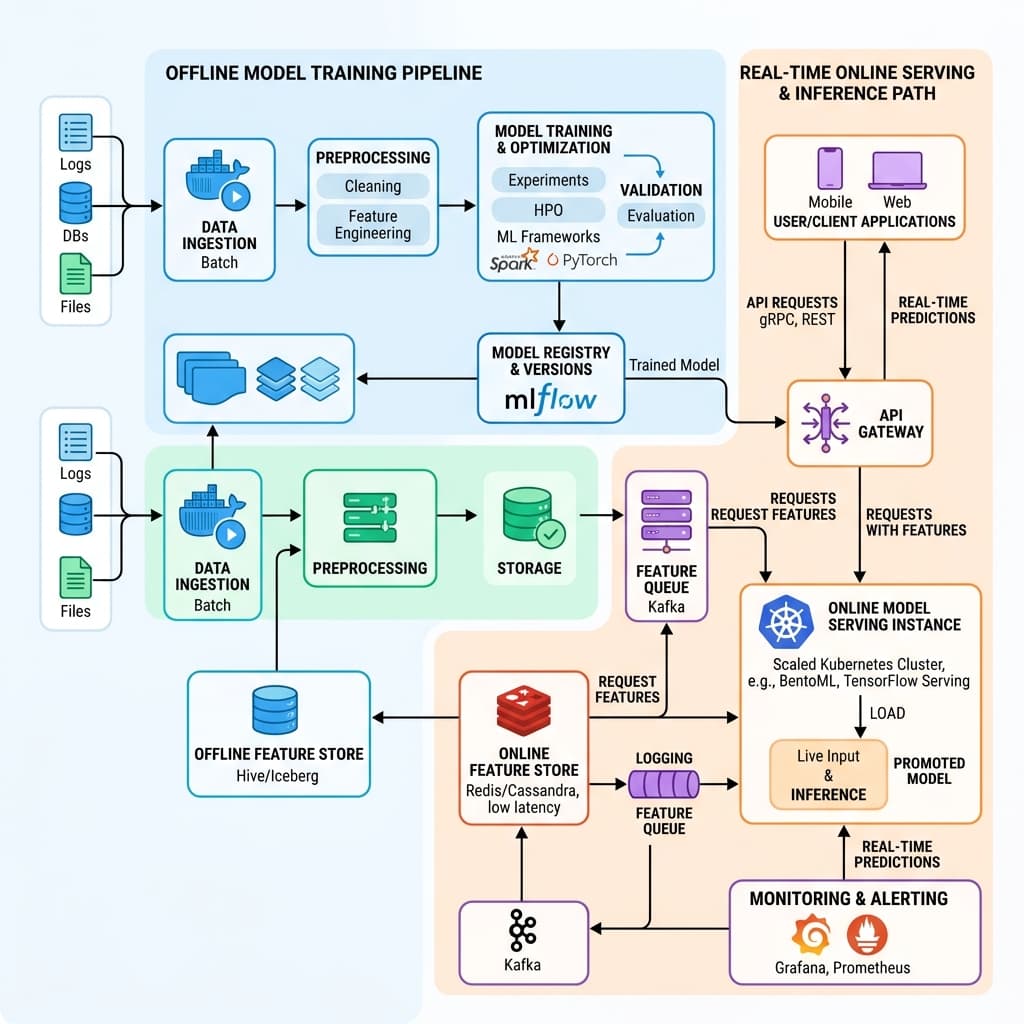
Sophisticated point in time historical log joins fundamentally represent the critical moral center of any predictive machine learning system. If your massive scalable offline training pipeline accidentally logically peeks at forbidden future dataframe rows, your gorgeous presentation uplift evaluation charts will politey lie incredibly convincingly right until live production brutally humbles your engineering leadership.
Formal pipeline schema evolution profoundly needs explicitly forward compatible serialized readers paired with universally documented default failover policies specifically protecting completely missing required feature arrays. Relying heavily upon implicit zero value integer fills specifically to quietly repair broken categorical counts can completely mathematically invert critical upstream predictive model behavior entirely invisibly.
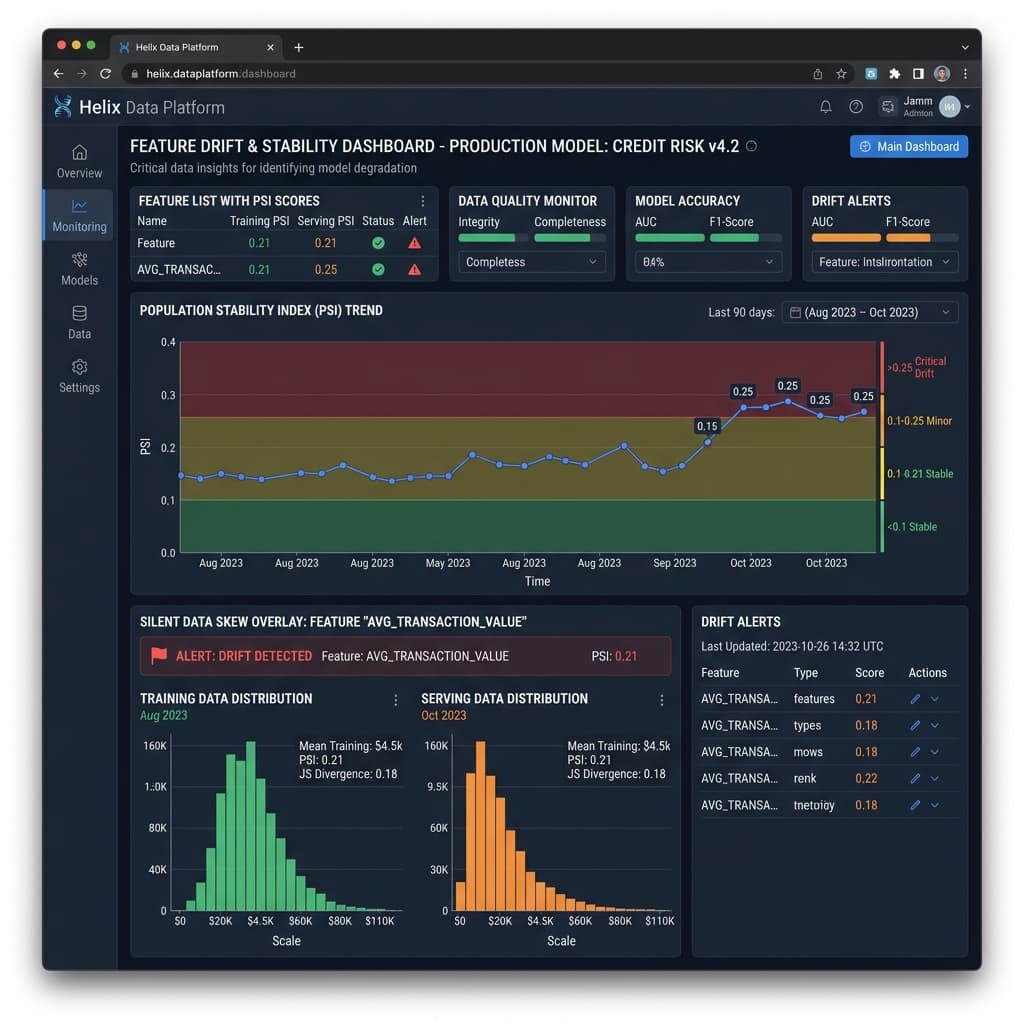
Engineering teams must ruthlessly structurally separate raw pipeline data quality integrity checks completely completely from complex mathematical model performance evaluation checks. Classic metric receiver operating characteristics like aggregate AUC can look wonderfully stable on a dashboard while a deeply protected demographic subgroup severely drastically drifts merely because external societal base rates moved slightly.
Ultimate operational ownership should exclusively sit directly with the embedded domain tactical teams who genuinely understand the exact underlying business definition of each specific feature vector rather than resting upon a completely generalized central platform group that merely blindly hosts the core storage infrastructure.
Platform engineers must rigidly execute periodic background reconciliation batch jobs that systematically compare complex offline recomputation slices directly against raw online production logs for randomly sampled customer entities. That tedious boring validation practice dependably catches bizarre silent encoding bugs that fancy statistical aggregations consistently inevitably miss.
We facilitate small-group sessions for customers and prospects without requiring a slide deck, focused on your stack, constraints, and the decisions you need to make next.