Insights · Report · Data & AI · Mar 19, 2026
Identity resolution, consent enforcement, and governed activation paths for firms that must prove lineage and access control to supervisors.
Customer data platform initiatives attract attention because marketing wants speed and compliance wants control. Architecture patterns that succeed treat privacy and lineage as product requirements, not as late-stage gates.
We describe reference flows for retail banking, wealth, property and casualty insurance, and life insurance. Each vertical stresses different identifiers, different consent metaphors, and different latency needs for batch versus online decisioning.
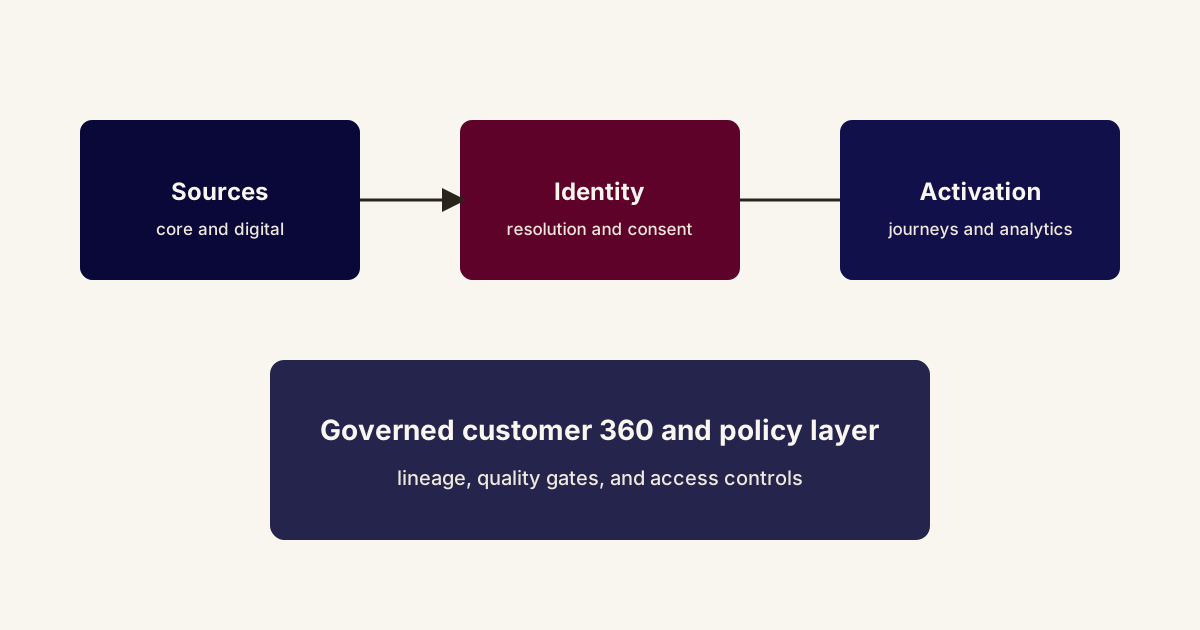
Identity resolution receives a full treatment: deterministic keys, probabilistic matches, household models, and the operational discipline required when matches change. Supervisors increasingly ask how you explain a merged profile to a customer who disputes it.
Consent and purpose limitation are modeled as enforceable policies in data planes, not only as text in privacy notices. The report lists integration points with campaign tools, service clouds, and internal analytics workspaces so engineers know where to attach checks.
Lineage and quality are paired. A column-level catalog without freshness metrics still fails model risk expectations. We propose minimum viable data quality SLAs for customer attributes that feed pricing, underwriting, or next-best-action models.
Activation paths cover batch exports, reverse ETL, event streams, and API lookups. Each path includes threat models: excessive privilege, token leakage, and accidental PII in logs. Security architecture reviewers can use the checklists as standard work.
The closing chapter compares build versus buy decisions for entity resolution engines, feature stores, and journey orchestration. The goal is not a universal answer; it is a decision record template that captures trade-offs your board can understand.
Appendices include RFP language for vendors, sample definitions for golden customer records, and test cases for access reviews. These artifacts reduce rework when internal audit or external examiners ask for repeatable evidence.
We can present findings in a working session, map recommendations to your portfolio and risk register, and help you prioritize next steps with clear owners and timelines.