Insights · Report · Operations · Apr 2026
AMR fleets, WMS truth layers, peak season degradation modes, and integration risk when robotics vendors and ERP systems disagree on inventory state.
E-commerce volume growth and just-in-time retail fulfillment continue to pressure warehouses toward greater automation in picking, packing, and sortation. Throughput gains from autonomous mobile robots, goods-to-person stations, and automated storage and retrieval systems are well documented. Yet these gains depend on software orchestration layers that introduce new fragility. When network latency spikes, map data drifts, or a robotics controller loses synchronization with the warehouse management system, throughput does not degrade gracefully. It collapses.
This report centers on inventory truth: the principle that a single authoritative model for on-hand, allocated, and in-transit quantities must be reconciled continuously across warehouse management systems, transportation management platforms, order management engines, and automation controllers. Without a shared source of truth, discrepancies compound during peak periods. A robot picks from a location the WMS has already deallocated, a carrier manifest references quantities the ERP has not yet confirmed, and customer-facing availability promises diverge from physical reality.
WMS resilience begins with architecture decisions made long before peak season. Organizations that deploy their WMS as a monolithic on-premise instance face different failure profiles than those running cloud-native, microservices-based platforms. On-premise systems offer predictable latency but concentrate risk in a single failure domain. Cloud-hosted systems distribute risk across availability zones but introduce dependency on network connectivity and vendor uptime commitments. Neither model is inherently superior; the critical variable is whether the operations team has rehearsed recovery for each failure mode.
Degradation modes deserve explicit engineering attention. A partial automation outage, where half the AMR fleet loses connectivity while the other half continues operating, creates more complex recovery scenarios than a full shutdown. Operators must decide in seconds whether to halt all robotic activity and switch to manual picking or attempt to isolate the affected zone and continue partial operations. These decisions should be codified in runbooks with clear escalation thresholds, not improvised under pressure during a peak sales event.
Autonomous mobile robots require digital twin accuracy that most warehouse operators underestimate. Layout changes, temporary pallet placements, maintenance barricades, and human overrides must propagate to robot navigation maps within minutes, not hours. Stale map data causes congestion cascades where robots queue behind obstacles that no longer exist or route through aisles that have been temporarily blocked. The resulting gridlock compounds exponentially as more robots enter the affected zone, each one waiting for a clear path the navigation system believes should be available.
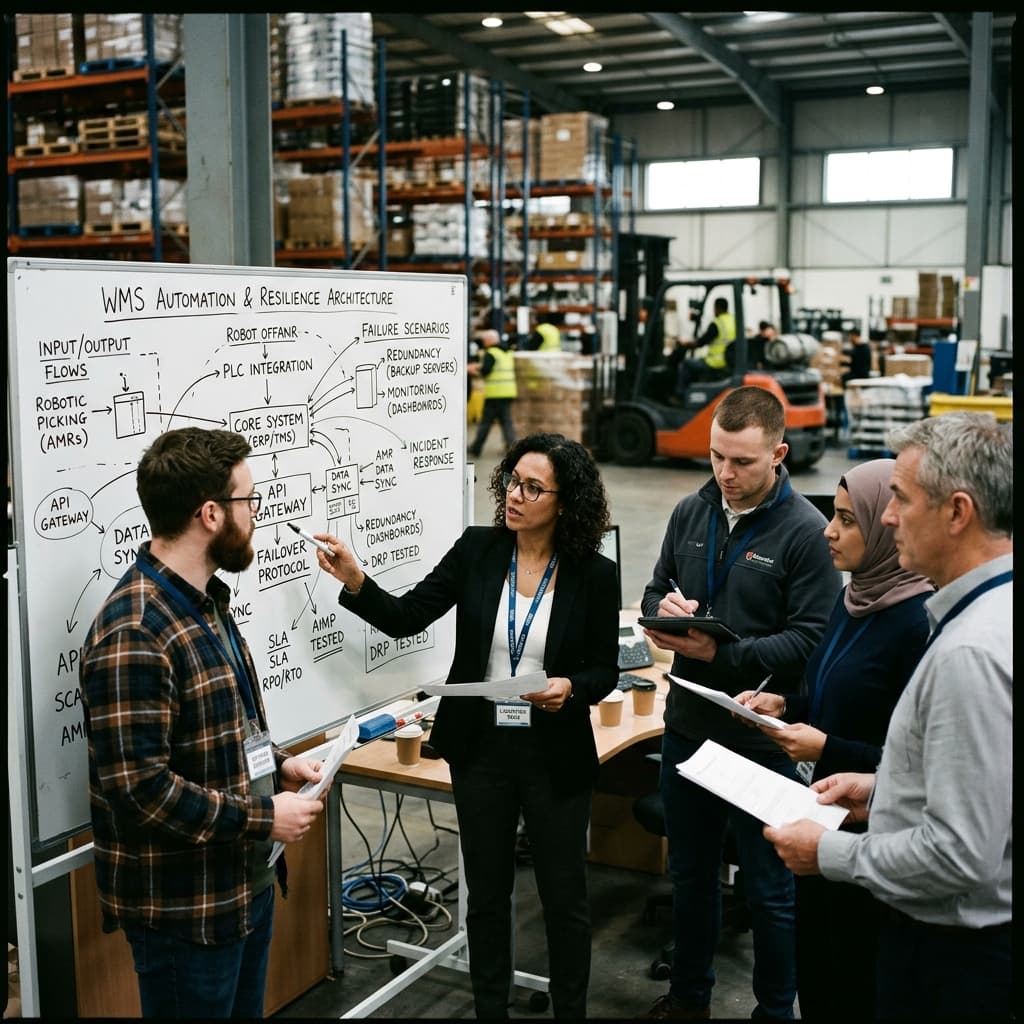
Integration risk between robotics vendors and enterprise resource planning systems represents one of the most underappreciated failure domains in warehouse automation. AMR fleet management software typically maintains its own inventory position, tracking which items have been picked, which are in transit on a robot, and which have been delivered to a packing station. The WMS maintains a parallel view. The ERP holds yet another perspective. When these three systems disagree on inventory state, consequences range from mispicks to phantom stock that blocks replenishment orders.
Resolving inventory disagreements requires a clearly defined reconciliation hierarchy. Organizations must designate which system serves as the authoritative source for each inventory state transition. The WMS should own location-level allocation decisions. The automation controller should own in-motion status. The ERP should own financial inventory valuation. Interface contracts between these systems must specify reconciliation frequency, conflict resolution rules, and alerting thresholds for discrepancy counts that exceed operational tolerance. Without this hierarchy, troubleshooting inventory errors during peak becomes a multi-team forensic exercise.
Real-time data exchange between automation systems and the WMS demands robust middleware that can handle message bursts during peak throughput. Message queues should be sized for sustained peak volume with headroom for retry backlogs. Dead letter queue monitoring must trigger operational alerts, not just log entries, because a stuck message representing a completed pick that the WMS never acknowledged creates a downstream cascade of allocation errors. Idempotency guarantees on both the publishing and consuming sides prevent duplicate transactions during recovery sequences.
Peak season planning must extend beyond capacity provisioning to include explicit degradation rehearsals. Quarterly chaos drills that simulate partial automation failure, WMS database failover, and network segment isolation give operations teams muscle memory for scenarios that cannot be fully scripted. These drills should be measured not only by recovery time but by order accuracy during the degraded period. A fast recovery that ships incorrect orders creates returns volume that amplifies the original disruption for weeks afterward.
Cybersecurity in warehouse automation environments requires dedicated attention beyond standard IT controls. Robot management consoles, wireless access points serving AMR communication, and programmable logic controllers on conveyor systems all represent attack surfaces with direct operational impact. Ransomware that encrypts pick instruction databases halts fulfillment instantly, with revenue impact measured in hours, not days. Network segmentation that isolates operational technology from corporate IT, combined with privileged access management for automation administrative interfaces, belongs in the baseline architecture from day one.
Wireless network design for AMR fleets demands coverage planning that accounts for the metal-rich, high-interference environment of a working warehouse. Dead zones near racking, signal attenuation from stacked inventory, and interference from nearby facilities can all cause robots to lose connectivity and stop in place. Redundant access points with seamless roaming, dedicated SSIDs for automation traffic, and continuous signal strength monitoring are operational necessities. A warehouse that treats its automation wireless network with the same rigor as a data center backbone avoids preventable outages.
Labor planning intersects technology more deeply than most automation business cases acknowledge. The promise of reduced headcount often obscures the need for a differently skilled workforce. Technicians who can diagnose robot hardware faults, operators who can switch between automated and manual picking modes, and supervisors who understand both system dashboards and floor-level exception handling represent a workforce profile that takes months to develop. Training programs for these hybrid crews reduce mean time to recover when exceptions spike beyond what automation can handle autonomously.
Ergonomic outcomes for human workers operating alongside robots deserve explicit measurement. Goods-to-person stations that present items at optimal heights reduce repetitive strain injuries, but poorly calibrated presentation speeds create cognitive overload that degrades both accuracy and worker wellbeing. Metrics should include human ergonomic indicators such as repetitive motion counts, station cycle time variance, and worker-reported fatigue alongside traditional robot utilization and throughput figures. An automation program that improves throughput while increasing injury rates has not delivered genuine operational value.
Vendor diversification strategies for warehouse automation require careful evaluation of integration cost versus single-stack simplicity. A single robotics vendor provides a unified control plane and simplified support escalation, but creates concentration risk if that vendor experiences financial difficulty, discontinues a product line, or fails to keep pace with competitors. Multi-vendor environments distribute this risk but demand robust integration middleware and standardized interface contracts. The optimal approach for most mid-to-large warehouses involves a primary vendor relationship with documented abstraction layers that permit secondary vendor introduction without architectural rework.
Interface contracts between automation vendors, WMS providers, and internal systems should be documented with the same rigor as external API specifications. Message formats, authentication mechanisms, retry policies, timeout thresholds, and error code taxonomies must be agreed upon and version-controlled before deployment. These contracts should include performance baselines that define acceptable response times under normal and peak conditions. When a vendor upgrade introduces latency that exceeds contractual thresholds, the operations team needs a clear escalation path rather than an open-ended troubleshooting engagement.
Sustainability metrics such as packaging optimization, energy consumption per pick, and route efficiency within the warehouse should connect to telemetry data that the automation platform actually captures. Many organizations publish green commitments based on estimated rather than measured performance. Large retail partners increasingly require auditable sustainability data as a condition of continued vendor relationships. Connecting packaging waste sensors, energy metering on conveyor lines, and AMR battery efficiency data to a centralized reporting dashboard transforms sustainability from aspiration to verifiable operational practice.
Return on investment calculations for warehouse automation must account for the full lifecycle cost of the technology, including software licensing renewals, map maintenance labor, hardware replacement cycles, and the opportunity cost of warehouse downtime during system upgrades. Many initial business cases focus narrowly on labor savings and throughput improvement without modeling these ongoing costs. A realistic five-year total cost of ownership model that includes integration maintenance, vendor management overhead, and periodic resilience testing accurately represents the investment required to sustain automation benefits.
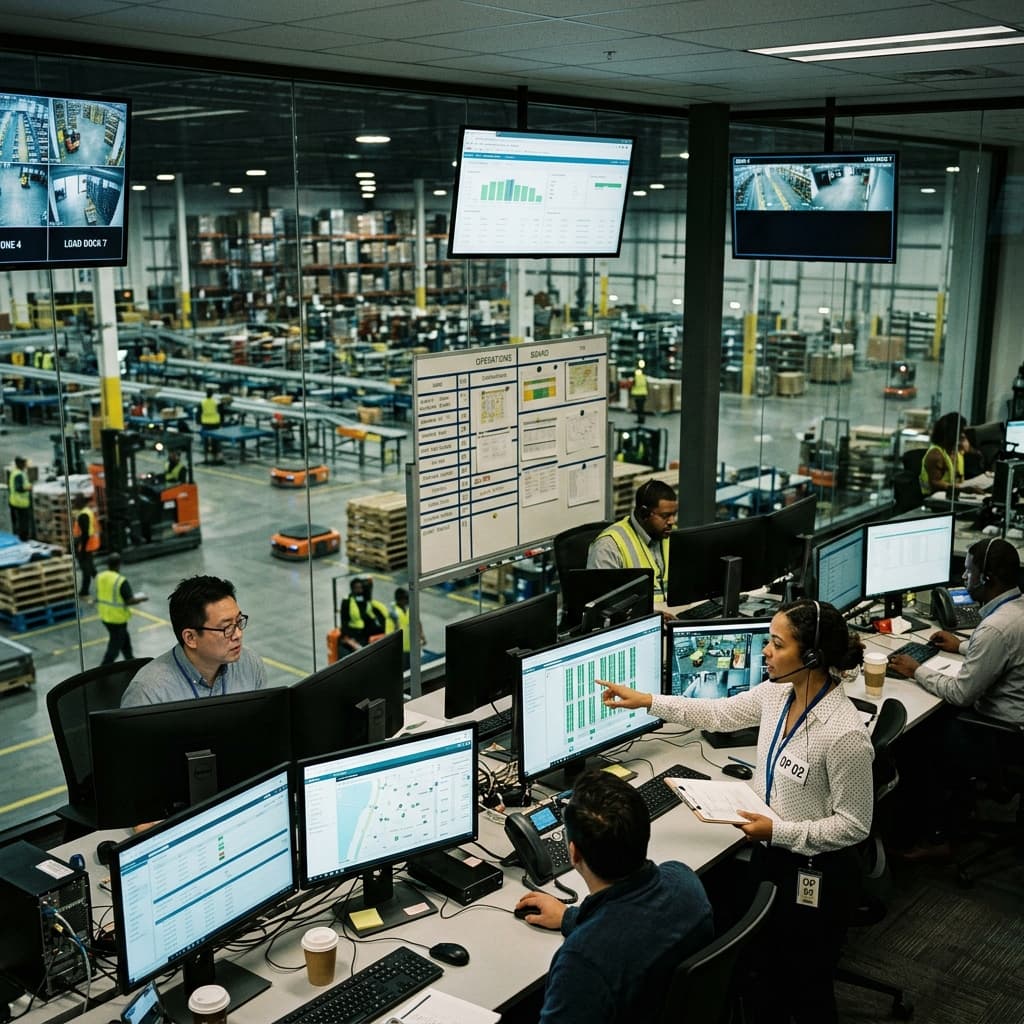
Executive dashboards for warehouse operations should present information that drives decisions, not merely reports status. Backlog age by fulfillment lane, carrier cutoff countdown by shipping mode, exception rate by automation zone, and inventory accuracy by storage type give leaders the context to intervene before customer promises are broken. Dashboards that only display aggregate throughput numbers mask the localized bottlenecks and emerging failures that determine whether the warehouse meets its service-level commitments during the hours that matter most.
Organizations preparing for the next peak season should begin with three foundational actions. First, conduct quarterly chaos drills simulating partial automation outage and measure both recovery time and order accuracy during degradation. Second, verify cross-training roster depth so that every automated zone has at least two operators capable of running manual fallback procedures. Third, audit interface contracts between all automation vendors and internal systems, confirming that reconciliation hierarchies, escalation paths, and performance baselines are documented, current, and understood by the operations team.
We can present findings in a working session, map recommendations to your portfolio and risk register, and help you prioritize next steps with clear owners and timelines.