Insights · Report · Industry · Apr 19, 2026
Slice design, SLA enforcement, security isolation, and commercial models for carriers selling deterministic wireless to industry and public sector buyers.
Network slicing promises differentiated performance on shared infrastructure. Enterprises ask whether slices truly isolate failure domains and whether billing aligns with measurable latency, jitter, and packet loss commitments.
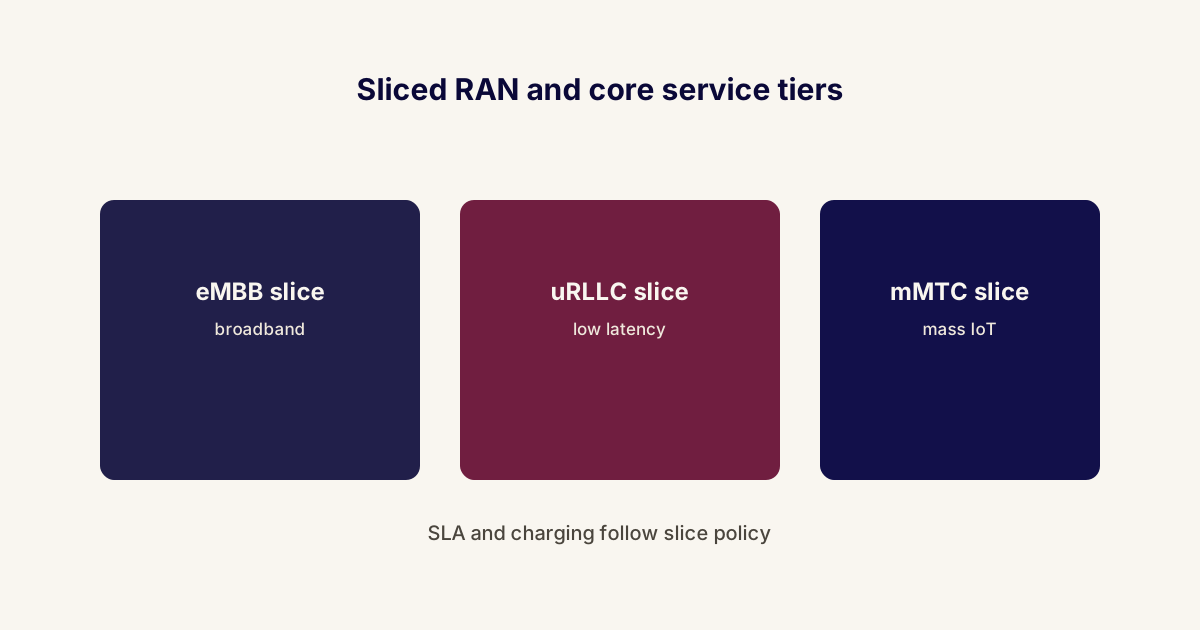
The brief explains slice types in business terms: enhanced mobile broadband for high throughput campuses, ultra-reliable low latency for robotics and control loops, and massive machine type communications for dense sensor fields.
End-to-end observability requires agreements on measurement points. Customer dashboards should reflect radio, transport, and core segments with shared definitions. Disputes thrive on ambiguous averages.
Security isolation spans user plane separation, management plane access controls, and lawful intercept processes where regulations apply. Document who can reconfigure a slice and under what approval path.
Edge computing partnerships complicate support models. When hyperscaler stacks sit beside user plane functions, runbooks must clarify incident ownership and data residency promises.
Commercial constructs include committed information rates, burst policies, and penalties tied to SLO breaches. Legal templates should avoid vague best effort language for mission workloads.
Migration guidance covers Wi-Fi coexistence, private 5G versus public slice tradeoffs, and device certification programs. Unsupported handsets undermine slice guarantees.
We close with procurement checklists for enterprises and RFP response guidance for carriers. Alignment early prevents expensive redesign after spectrum and site work is done.
We can present findings in a working session, map recommendations to your portfolio and risk register, and help you prioritize next steps with clear owners and timelines.